01 — Science

From death of stars to dawn of life

I'm an astronomer at Konkoly Observatory, working in computational astrophysics. I aim to connect theory results to clear observables through papers that tell a story.
Topics

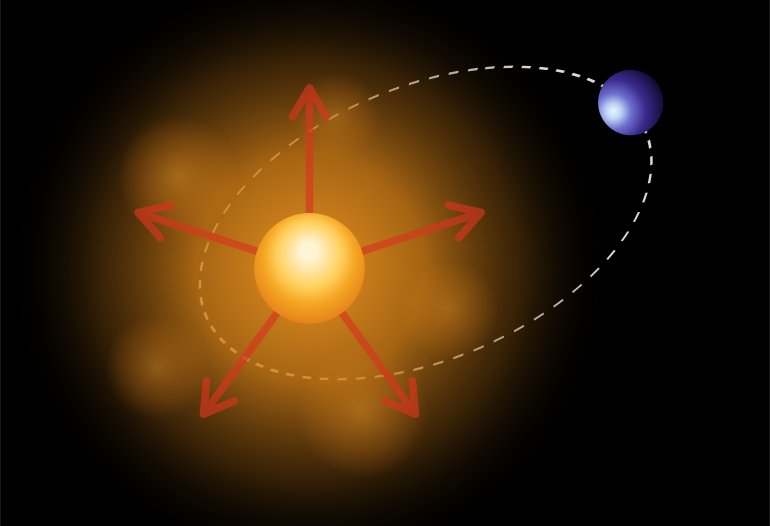
A star shedding mass while a companion orbits at the far point of its orbit
Dynamical effects of mass loss

How exploding massive stars reshape their companions' orbit — forming pulsar planets, double neutron stars, and rogue planets.
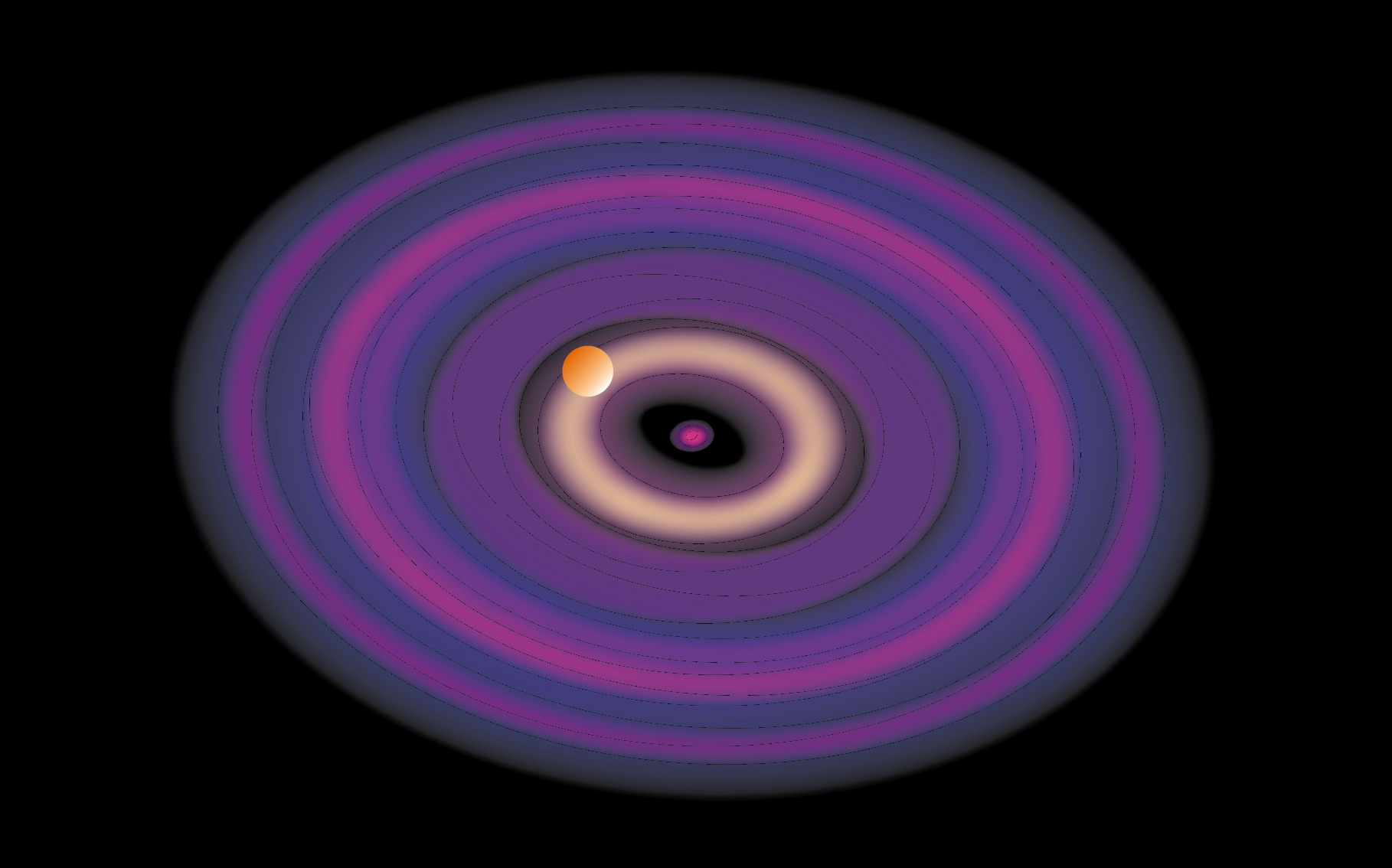
A disk around a white dwarf with a disintegrating planet
Signs of disintegrating planets

What the gas disks around metal-polluted white dwarfs and the infrared Ca II emission reveal about the slow death of exoplanets.
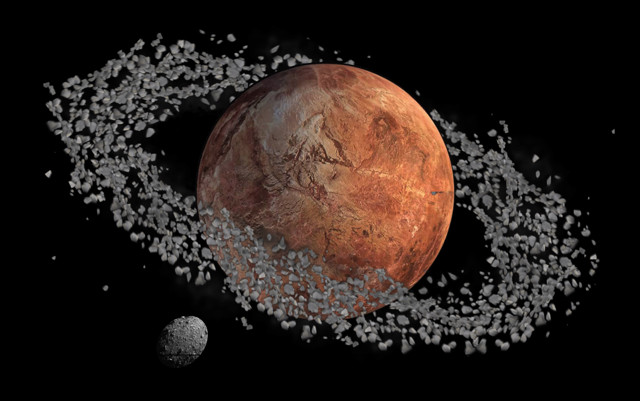
Asteroid with ring and moon
Celestial sunflowers

How the rings and moons of asteroids and trans-Neptunian objects of all shapes and sizes survive radiation pressure.

Papers

2026

Rings Around Non-spherical Worlds: Sub-mm Dust Retention Around Triaxial Small Bodies in the Solar System

Zsolt Regály, Viktória Fröhlich, Csilla Kalup & Csaba Kiss
PASP · 138, 054401
2025

Life in the Dark: Potential Urability of the Moons of Rogue Planets

Viktória Fröhlich & Zsolt Regály
A&A · 704, A349

Limits of Standard Tidal Models at Quaoar: Matching Weywot's Orbit, Missing the Spin

Zsolt Regály, Viktória Fröhlich & Csaba Kiss
PASP · 137, 114401

Fine-tuned Supernova or Failed Explosion? Decoding the Origins of the G3425 Binary

Zsolt Regály, Viktória Fröhlich & József Vinkó
ApJL · 988, L7

Celestial Sunflowers: Survival of Rings around Small Planetary Bodies under Solar Radiation Pressure

Zsolt Regály, Viktória Fröhlich & Csaba Kiss
A&A · 697, A116
2024

Origin of Ca II Emission around Polluted White Dwarfs

Viktória Fröhlich & Zsolt Regály
A&A · 692, A25
2023

Mitigating Potentially Hazardous Asteroid Impacts Revisited

Zsolt Regály, Viktória Fröhlich & Peter Berczik
A&A Letters · 677, L6

Double Neutron Star Formation via Consecutive Type II Supernova Explosions

Viktória Fröhlich, Zsolt Regály & József Vinkó
MNRAS · 523, 4957–4969
2022

Lost in Space: Companions' Fatal Dance around Massive Dying Stars

Zsolt Regály, Viktória Fröhlich & József Vinkó
ApJ · 941, 121

As an educator I want to show people the beauty of the night sky and that science and art are really just the two sides of the same coin.

Much of this work is done as vice president of the Vega Astronomical Association.

Articles are written in Hungarian. Titles are translated for clarity. Full list or English translation available on request.


Library

A page of writing
Index · All articles

The full archive of my popular-science writing at the Vega Astronomical Association.

Browse articles →

Sound waves
Talks · Recorded

The archive of my popular-science talks recorded mostly by GalileoWebcast.

Browse recorded talks →

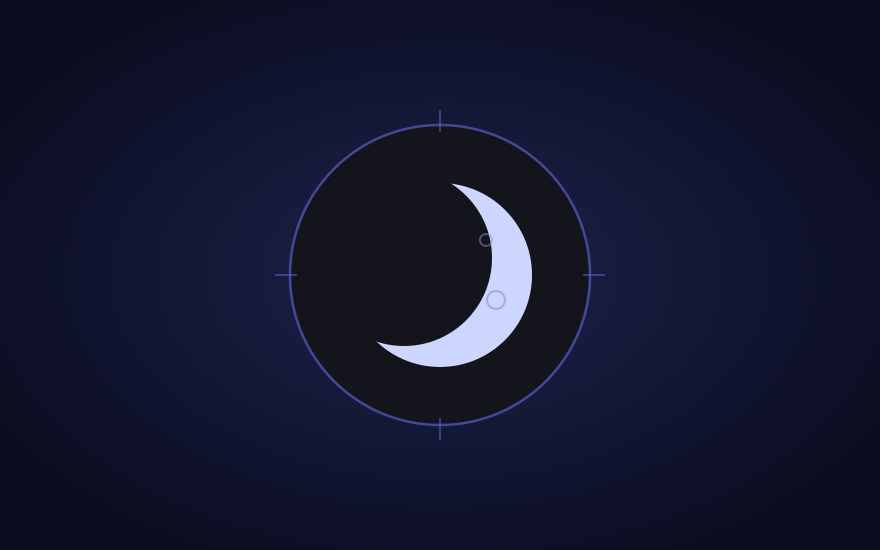
A crescent moon sketched in an eyepiece
Sketches · Observational

Taking the night home: eyepiece drawings of the Solar System and deep-sky objects.

View sketches →

Definitive works

Article · 2026HU

Finding an atmosphere on a TNO beyond Pluto?

How do you know a small body has an atmosphere and why is this small object capable of its retention?

Read →
Short Series · 2026HU

Contemplative stardust

Where are we, where are others? How do planets form? How do we search for life outside the Solar System?

Read →
Short series · 2025HU

Life in extreme environments

Interviews on how life could survive on the wildest known exoplanets: without a star or orbiting a pulsar.

Read →
Talk · 2025HU

Ask the Astronomer! IV.

Round the table conversation with professional astronomers at the VEGA'25 amateur astronomy astrocamp.

Watch →
Talk · 2025HU

Habitability

What are the building blocks of life, and where can we find them? How rare is life, really?

Watch →
Essay · 2025HU

Look sweetie, there is Polaris!

How to touch the souls of professionals who never saw the night sky. Amateur astronomy @ a scientific conference.

Read →
Article · 2025HU

Thoughts on exomoons and their habitability

How can an moon of another planets sustain life? Can they be the first cradle for extraterrestrial beings?

Read →
Talk · 2025HU

110 brushstrokes of the Universe

Telling the stories behind drawing all of the 110 Messier objects.

Watch →
Essay · 2024HU

From dusk till dawn: amateur astronomy @ Piszkéstető Station

Spending a whole night under the summer sky with co-workers. My most awe-inspiring text.

Read →
Essay · 2022HU

Reflecting on the VEGA'22 astrocamp

How to spend your time most wonderfully in a commintiy so strong and such in awe of the night sky.

Read →
Article · 2022HU

TOI-500, an expolanet system with a peculiar past

Interview with the discoverer of one of the most intriguing exoplanetary systems today.

Read →
Article · 2022HU

Silent black holes

How the most massive stars end their lives - not in a bang, but a silent collapse.

Read →

Talks I love to give — for clubs, observing nights, schools, companies, and friend groups. Each can be tuned for the audience and age group, and is available both in HUN and ENG. Want one of these (or something new)? Get in touch →

Teasers

General audience

The romance of astronomy

What does the astronomer see when she looks up at the night sky? What is there to explore in the vastness of the Universe? How small are we when compared to the largest galaxies?

50 min+ Q&AIntro to astronomy
Invite this talk →
Science-y

Space rocks - Stories of asteroids & comets near and far

Our Solar System is full of small bodies: some spend eons without ever being detected, some swing by the Sun as comets, and some just pass by. Oh, and did you know they have rings and moons?

45 min+ Q&AHot topic
Invite this talk →
Curious-philosophical

Contemplative stardust

Where are the atoms making up our bodies forged? How do planets like Earth form and are we alone in the Universe? Thought-provoking questions at the edge of science and wonder.

60 min+ Q&AThe big questions
Invite this talk →
Curious-philosophical

Habitability of worlds beyond the Solar System

Why did life develop only on Earth? Why is it so hard to find life on other planets? What makes a world bearabel to live on and could we ever find traces of alien biology?

45 minQ&AThe big questions
Invite this talk →
Science-y

Dance of hungry ghosts - How stellar remnants eat up planets for breakfast

White dwarf stars are the graveyard of stellar evolution. And they also devour planets - but how? How can we see such disrupting planets and what can we say about the processes that destroy them?

50 minQ&AHot topic
Invite this talk →
General audience

Professional results from amateur astronomers in Hungary

In this talk I show the most interesting and sometimes funny stories of Hungarian amateur contributions to the biggest questions of the Universe.

10-30 minQ&ARetrospective
Invite this talk →
Science-y

From the death of stars to the dawn of life

How do stars end thier lives and why is this extremely important for the emergence of life both on Earth and other planets? Stellar explosions might not mean the end after all!

50 minQ&AHot topic
Invite this talk →
Awe-inspiring

Fresh results from the largest space telescopes out there

Let's talk about the most mindblowing images of the Universe ever taken - in clear and understandable detail, from the eye of an artistic astronomer.

50 minQ&AHot topic
Invite this talk →
Anyone and everyone

Telescope night under the starry skies

Let's see what the Universe has to offer with our own eyes! From the nebulae of the Summer to the star clusters of Winter, there is something for all audiences to show and experience!

30-180 minQ&AUnder the stars
Invite this talk →
On fees: there's no fixed rate — every talk is different, and I set it per invitation depending on the audience, format, travel, and whether it's a school, a club, or a larger event. Tell me what you have in mind and we'll find something that works.